
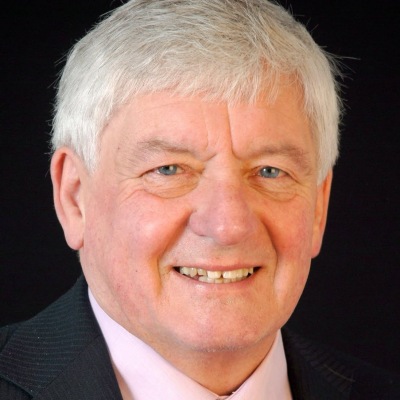
John Owen was born at Tŷ’n Coed, Tregaian on Anglesey in August 1940. Indeed, many still knew him as ‘John Tŷ’n Coed’, and the farm and its surrounding areas in the shadow of Mynydd Bodafon were very important to him throughout his life. He went to Capel Coch School and received a solid foundation at Tŷ Mawr chapel in the village. His father and brother were prominent figures there, and his nephew Trystan is now a deacon there.
After his secondary education at Llangefni School he went on to study Welsh at Aberystwyth University. But it was subsequently, after going to study theology in Bangor, that one of the turning points of his life came, as it was there that he met Mam, Ann Ellis from Aberdaron.
It was in Bangor too that his relationship with another love started – the world of theatre. One great privilege he had there was playing the main role, Morgan Llwyd, in Bangor University’s production of John Gwilym Jones’s play “Hanes Rhyw Gymro” in 1964. Despite the lure of the theatre though, there was another voice calling.
He was ordained as a minister in Llanberis, and soon he and Mam took on a central role in village life there. He was very proud that he had been able, in a small way, to help some of the talented youngsters of Llanber at the start of their musical journey. But it’s also certain that Wales has reason to be grateful that he was not invited to sing with “Hogia’r Wyddfa”! Arwel and Myrddin from the group were among the first members of the Llanberis Drama Company founded by Dad in 1964. That successful venture has now been incorporated into the cultural space Y Festri, on the site of Gorffwysfa chapel where he was minister.
He was also an active member of the Llanberis branch of Plaid Cymru and part of the enthusiastic team thrilled by the election of Dafydd Wigley as MP for Arfon in both General Elections in 1974. In the Seventies he was also part of the campaign for a Welsh language TV channel and appeared in court for refusing to pay his licence.
After moving to be a minister in the Vale of Clwyd in 1977 he threw himself into Ruthin’s Welsh cultural life by helping to set up local paper “Y Bedol”. He used his experience as one of the founders of “Eco’r Wyddfa” to get the Vale of Clwyd publication off the ground. He also set up Ruthin Drama Company and gave a young blonde boy his first chance to act on stage. That was Rhys Ifans, and he went on to follow his brilliant career with great interest.
The campaign against nuclear weapons was at its peak in the mid-80s. In 1985, he, along with three other ministers – Pryderi Llwyd Jones, John Tudor, and Islwyn Lake – was arrested for trying to break part of the fence around RAF Molesworth in Cambridgeshire. That symbolic action was in the name of the Fellowship of Reconciliation, a movement that Dad, as a pacifist, supported for decades.
He also continued to be active with Plaid Cymru, canvassing and campaigning on behalf of several candidates from Ieuan Wyn Jones in the Denbigh constituency in 1979 up to the more recent period of having Llŷr Gruffydd as Member of the Senedd.
As a dedicated supporter of Wrexham Football Club he was part of the campaign to give greater attention to Welsh on match days. With the support of Dai Davies, the club’s goalkeeper at the time, Welsh language announcements were introduced during games and Welsh articles were included in the official programme.
But he also faced several heavy blows during his time in Ruthin. First, losing his younger brother Emyr, who had always supported him with his wise advice and friendship. And then in 1992, losing Mam. As a family, we had no idea how he would manage without Mam’s love and inspiration by his side. But luckily he met Gwenda. And so another teacher came along, to reignite the flame in his heart. They had a happy quarter century together before Gwenda lost her battle with Motor Neurone Disease (MND).
A major theme in Dr. John Gwilym Jones’ plays – a hero and good friend to Dad – is the idea of a calm centre. Often the main character tries to find peace of mind while tensions and storms rage around them. It’s a mystery to us how Dad managed to find that calm centre despite these untimely and shocking losses. Naturally, after losing Mam and Gwenda, the charities Tenovus and the MND Association became important to him. By publishing his collection of englynion, “Colli Briwsion”, he managed to raise over £3,000 to be shared by the two charities.
During his career as a minister, he had the privilege of being President of the North Wales Assembly, and was President of the General Assembly in 2004. In that role, he represented the Presbyterian Church of Wales in India, taking part in events marking the centenary of the death of John Roberts, an early Welsh missionary. In the town of Shillong in the Khasi Hills, there is a memorial with John Owen’s name inscribed on it.
From the cattle shed at Ty’n Coed to the Khasi Hills, it was quite a journey. And that journey was not in vain. With great determination and tireless campaigning, yes, we got a TV channel. Yes, American Cruise missiles were removed from RAF Molesworth. Yes, we got more Welsh on the Racecourse. Yes, Dad did get, in the last weeks of his life, the thrill of seeing a Plaid Cymru government elected in Cardiff Bay.
And yes, Huw and I had a special Father. Thanks, Dad.
Dafydd Owen