
Charles Cravos (1944-2026)
The Plaid Cymru History Society is grateful for permission to publish two tributes to Charles Cravos, who died on 1 October 2026. One is written by his three sisters, and delivered by his neice Amanda, and the other by his son Steffan.
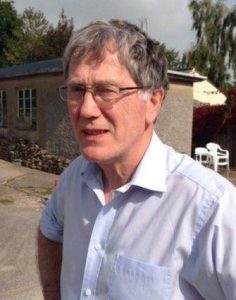
I first met Charles during the late Dr Dafydd Huws’s successful campaign to win Plaid Cymru’s first ever seat on Cardiff City Council in the Plasmawr ward in 1969. Charles threw himself into that campaign and into all his work for Plaid with characteristic enthusiasm. He brought the same zest to the task of learning Welsh.
He was not your ‘typical Plaid Cymru member’ (by the way I don’t think there is such a thing). Charles took pride in his exotic background, with a heritage that embraced the Greek diaspora of Trieste as well as Irish, as you can read in the tributes.
He was adept at persuading family members and friends to help the cause. The epic Plaid Cymru motorcade during the Caerffili by-election of 1968 is remembered by many, but not everyone knew that the open Gilbern sports car in which our candidate Phil Williams led the way was provided by Charles’s brother-in-law.
Charles went on to stand as Plaid candidate in the Ely ward in Cardiff West and then took up a full-time post as administrative officer at the Plaid HQ in Queen Street, Cardiff.
He and Menna moved to Carmarthenshire, living in Llansadwrn and Tanerdy, Carmarthen, with their children Steffan and Lleucu, where he played an active role in Plaid Cymru’s work in a crucial constituency.
Later still, he and his second wife Jane lived in Llanfihangel Tal-y-llyn, Brycheiniog. He is buried in the church of St Gastyn at Llangasty near Llangorse lake, where local legend has it that the birds would only sing for the true Welsh prince. It is a fitting resting place for a patriot.
Charles was totally committed to Wales. And he was fun. Rest in peace, hen ffrind.
Dafydd Williams
Tribute by Steffan Cravos
Today, I’m here to pay tribute to my father, a man who influenced my life in a number of ways.
As a young man, Charles decided to take a stand for Wales and the Welsh language. After finishing his formal education in England and returning home to Cardiff, he immediately went on to join Plaid Cymru and start campaigning tirelessly for the national movement. In his twenties, he decided to learn Welsh. Over time, he became a fluent Welsh speaker, and my sister Lleucu and I were raised in a Welsh-speaking household because my mum, Menna, was also a Welsh speaker.
Charles was very proud to be Welsh and campaigned tirelessly for his country’s language and culture. He taught me the value of Wales’ cultural wealth and how important it was to support and celebrate it.
Growing up in Carmarthenshire, I remember sitting around the family dinner table listening to my parents discussing current affairs, history, and politics. Charles was an avid reader and extremely knowledgeable. He had an alternative and unconventional view of the world.
He took pride in the fact that he descended from Irish people who settled in Cardiff following the Irish potato famine. This was a topic very close to his heart, and he would often talk about it around the table. His awareness of his Irish heritage meant he had deep sympathy for Ireland’s history and its heroic resistance against British oppression. He would always side with the oppressed, arguing against injustice and tyranny, and in favour of justice and fairness.
Through example and conviction, he taught me the importance of taking a stand against injustice and of standing up for my principles. In addition to this, he also taught me that material things do not necessarily make a person happy and that the company of family and friends are more important values.
Nevertheless, Charles also enjoyed pulling legs. When I was twelve years old, and he was in his forties, he told me and Lleucu that he was actually 86 years old and had a wooden leg. He would also confirm this by showing a copy of his father’s brother’s birth certificate, who was also named Charles Cravos but was born in 1901.
Charles was a gentle character who was always ready to do good. He was supportive of me and my sister throughout the years and a loving father. Charles remained very active throughout his life and was never still for too long. Later in life, he settled in Llanfihangel Tal-y-llyn, continuing to be active after retiring from his work in Tenovus. He was always very welcoming to me when I visited him at his home with Jane at Tŷ Canol and would take me for walks, showing me around the area where he was always remarkably knowledgeable about the local history.
His love and support will stay with me forever. I know that Charles is now at peace. I am proud to be your son and I will carry your memories with me forever.
Thank you for everything Charles.
Tribute to Charles Cravos by his sisters, and delivered by his niece Amanda
Today, we remember Charles – a much-loved husband, brother, father, grandfather, uncle, cousin and friend, and, above all, a very kind and gentle man. These memories come from his three sisters, Jen, Judy and Steph, who knew Charles from the very beginning.
Charles was born and grew up in Flintshire, where the family had moved while their father was convalescing from tuberculosis. They had a wild and carefree childhood full of fun! It was then that his character began to emerge. When he and his younger brother Pat were babies, they were often wheeled around together in a very large Victorian pram. Charles, being the older of the two, discovered the advantages of being first in line – and would regularly steal Pat’s bottle. Perhaps this is why he was always smiling.
A few years later there was the donkey. Charles had an air rifle and he discovered that if he shot the donkey on its bottom, it would bolt, leaving his sisters clinging on for dear life! Later, he went away to board at Douai School, where another side of his character began to show. He joined the debating society and was chosen as the Plaid Cymru candidate in the school’s mock election. This kindled a lifelong passion for politics and Welsh nationalism.
But Charles’s entrepreneurial spirit was also flourishing. While at school, he ran a roaring trade in contraband – selling all sorts to the boys and the monks. He would travel home at the end of each term by train with baskets of the school’s hens, which he then sold to the local butcher!
There was also the occasion of the raven. During an important O Level exam, Charles’s pet raven was tapping persistently at the window of the exam hall, disturbing everyone. Charles suggested to the monks that they let it in. They did, and the raven perched quietly on his shoulder and head for the rest of the exam!
His adventures and convictions continued into adulthood. On several occasions, when driving, he avoided paying the toll on the Severn Bridge by shooting through the toll booth on the tail of the car in front… having craftily changed his number plates beforehand. He didn’t see why on earth he should be charged to go into Wales!
When Charles was studying Law, his commitment to Plaid Cymru was such that he sent virtually every penny he had to the party. He became so short of money that his shoes were held together with string! His belief in Wales and the Welsh language remained with him throughout his life. He supported groups that taught Welsh to local people for many years.
And then, of course, there was his passion for Welsh rugby. Charles and his brother Pat had inherited their father’s skills on the rugby field, and both were talented and enthusiastic players. Rugby was clearly in their blood. Charles was a devoted supporter of Wales and loved going to watch the team play at Cardiff Arms Park. Few things could stir his enthusiasm quite like Wales taking to the rugby field. His love of Wales extended into so many parts of his life – its language, its culture, its politics, its people and, of course, its rugby.
Charles was also an avid walker and, for him, walking was very much an adventure rather than simply a pastime. Judy remembers him skipping a few days off school to hitch hike from Land’s End to John o’ Groats. He went on to walk the Seven Peaks and, in typical Charles fashion, even persuaded Steph to join him on a charity walk from Cardiff to Porthcawl. For Charles, this was something of a tame stroll – but for Steph, it was a mammoth undertaking!
Charles was immensely proud of his family history and devoted a great deal of time and energy to researching his ancestry. He worked tirelessly on the family tree and the history of the family shipping company, Cravos Brothers. His study at home is testament to this passion, filled with the documents and findings he gathered over the years.
His research took him back to the family’s beginnings on the Italian-Slovenian border, and uncovered some remarkable stories of his ancestors. One person in particular inspired enormous pride in Charles: Emilio Cravos, who was shot by the Austro-Hungarian army for supporting Italy.
His commitment to helping others was another constant. He devoted many years to working for charities – firstly for the Red Cross and then for Tenovus, the Welsh cancer charity, giving his time and energy to a cause that reflected his deep concern for people. Perhaps one of the clearest examples of Charles’s compassion came when he was still a young man. Following the Aberfan disaster, he rushed up to Aberfan with shovels from the Cravos Brothers depot and began digging to help rescue those buried beneath the slag.
Charles was a staunch Catholic, and his faith was another important part of who he was and the principles by which he lived his life. Charles was fortunate to experience happiness in his personal life. He was happily married to Menna for many years, and together they had two children, Steffan and Lleucu, who brought so much to his life, as did his two grandchildren, Seb and Gethin. Later on, it was wonderful to see Charles find happiness again with Jane. Jane, you have been a wonderful support to Charles and a dear friend to the family. You cared for Charles since he first fell ill several years ago. We know how much that care meant to him, and we want to thank you for everything you have done for Charles and for the support and friendship you have given his family.
He was always a supportive brother but especially so when, seven years ago, his younger brother Pat died very suddenly. At a time of terrible shock and grief, he was there for his family in his steady, caring and dependable way. His sisters have memories of a brother who was always smiling, always capable of surprising them, and whose life was lived with passion and purpose.
Charles was a very kind and gentle man. And although we shall all miss him enormously, we can also smile when we remember him because, I think, Charles would have wanted us to.
Rest in Peace Uncle Charles.