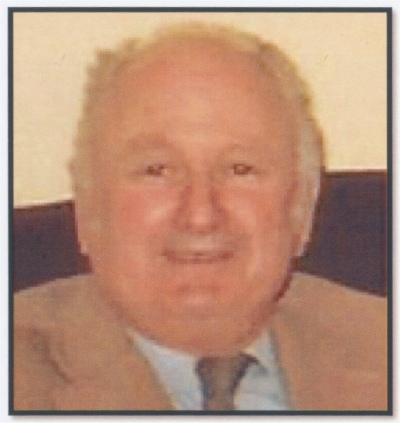
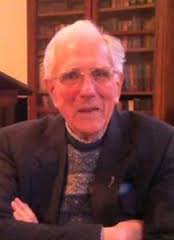
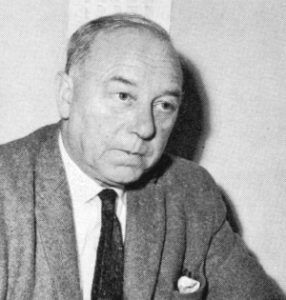
 Elwyn Roberts, the anchor man of Plaid Cymru throughout much of the twentieth century, was the topic of the Plaid history society’s 2017 annual Eisteddfod lecture. For all his apparent solid background in bank management, Elwyn Roberts was a committed and determined nationalist who put love of Wales before his professional career.
His work for Wales was described by former Plaid leader Dafydd Wigley, historian Gwynn Matthews and Elwyn’s successor as party general secretary Dafydd Williams. You can read the full text of their lectures and listen to a recording the session in the Societies’ tent in the 2017 National Eisteddfod in Ynys Môn.
Memories of Elwyn Roberts
Translation of the Address by Dafydd Wigley to the Plaid Cymru History Society,
Eisteddfod Ynys Môn; August, 2017
It is a pleasure to open this meeting to commemorate Elwyn Roberts, one of Plaid Cymru’s stalwarts, and appropriate that we should gather here on the Eisteddfod field in Anglesey, Ynys Môn, as he was also twice the organiser of the National Eisteddfod. For decades he lived in Bodorgan, although his roots were in Abergynolwyn, Meirionnydd. He was someone whose influence was to be felt throughout Wales.
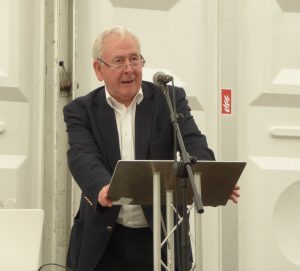 As a nation we have cause not only to respect Elwyn’s memory but also to carry on the contribution which he made, as an inspiration to a new generation to roll up its sleeves and complete his heartfelt ambition. He was a practical nationalist who believed that victory would grow from a foundation of political organisation – through harnessing human and financial resources in the service of our nation’s highest goals.
I pondered whether I could do justice to this subject, wondering whether I really knew Elwyn Roberts. Perhaps many who worked with him would admit similar feelings, because Elwyn, as well as being a national figure and a political heavyweight, was also a very private man.
Elwyn was one of half a dozen who had a substantial influence on me personally, drawing me – from a young age – to work for Plaid Cymru. The other national influences were Gwynfor Evans and Saunders Lewis; locally in Gwynedd Dafydd Orwig and Wmffra Roberts; and of my own generation, the late and beloved Phil Williams. It is worth noting that among these three were the sons of slate quarrymen – Dafydd Orwig, Wmffra and, yes, Elwyn Roberts.
Elwyn was the son of Evan Gwernol Roberts, a quarryman in Abergynolwyn; his mother, Mabel, was headmistress of an infants’ school. Abergynolwyn was so important to him that his autobiography turned into a volume of history about Abergynolwyn – he never spoke about himself! Thus he takes pleasure in the book that it was through the endeavours of Plaid Cymru in the 70s that quarrymen at long last won the right to dust disease compensation.
Elwyn was born in 1905, and was a child of his generation. The shadow of the first world war rested heavily upon him, as did the revolution in Ireland and the depression in the heavy industries. He had no university education – indeed, he had little regard for the education he received in Tywyn grammar school, which for him was far too English. After leaving school he went to work in the bank, where he would remain for a quarter of a century, first in Blaenau Ffestiniog, then Bethesda – two quarrying communities – and later Llandudno, rising to the position of deputy manager at scarcely thirty years of age.
He could have risen to the heights in the world of banking, but the future of Wales was more important to him than career or wealth. He joined the National Party in its early days; at the age of twenty-one, he set up the Blaenau Ffestiniog branch – the biggest branch throughout the whole of Wales. Then, as throughout his career, he worked strenuously in the background, leaving others to enjoy the limelight.
When war came in 1939, Elwyn refused to enlist in the armed forces, basing his action on nationalism rather than pacifism. He refused to recognise the right of the English state to compel him to fight for it. One of the Tribunal members asked him “You are standing as a Welshman, are you?”. Elwyn answered, with his withering humour, and his totally contemptuous view of the English establishment, “No, as a Chinaman!” He was ordered to work as a rat catcher in the Corwen area.
During the war – at the instigation of Saunders Lewis and J.E. Daniel – the “Committee for the Defence of Welsh Culture” was set up – in the words of Gwynfor Evans, “the most important national movement that worked for Wales during the war”. Rallies were organised throughout Wales, and the most successful of all these took place at Colwyn Bay. Gwynfor enquired who was responsible for attracting such a crowd. He was told that a young bank clerk had achieved this miraculous turnout. This was the first time that Gwynfor met Elwyn; and a partnership was forged that would influence the future of our nation.
The bank must have thought highly of him, because despite his fervent nationalism he was able to return to the bank before the end of the war. When Gwynfor stood for Merioneth in the 1945 election, he requested the bank to release Elwyn to work as organiser; and the bank agreed! Rhys Evans, in his biography of Gwynfor talks of Elwyn starring as election agent – and I quote – “for his proverbial toughness”.
Elwyn returned to the bank after the election; but his organisational ability was now well known, and he received an invitation to work as the organiser of the Colwyn Bay National Eisteddfod, 1947 – getting the bank to release him once again! He was headhunted once more to work as organiser for the National Eisteddfod at Llanrwst in 1951. This time he did not return to the bank, and was appointed by Plaid Cymru as its Gwynedd organiser and Director of Finance.
Another call came – to organise the cross party Parliament for Wales campaign. When Elwyn took over, the campaign had been running for two years but had attracted only a few hundred names. Elwyn took up the reins with his characteristic dedication, and succeeded in raising the number of signatories to over a quarter of a million. This led to S.O. Davies MP presenting a Parliament for Wales Bill in Westminster in 1956.
In 1958, Elwyn organised a successful tour of the United States by Gwynfor Evans. Gwynfor took part in a broadcast seen by twenty million people; he was warmly welcomed by John L Lewis, the leader of the United Mineworkers of America; and Elwyn organised an invitation for Gwynfor to meet President Eisenhower – only for the British Embassy to obstruct it.
Other requests flowed in. When the television company Teledu Cymru hit financial difficulties in 1962, it was to Elwyn that the call came, and he succeeded in raising investments for the venture, the equivalent of £1 million in today’s money. Fund raising was one of Elwyn’s strengths: it was he, later on, who persuaded a wealthy businessman to employ Gwynfor as a consultant between 1970 and 1974, after losing Carmarthen – and when Gwynfor, to all intents and purposes, was financially on the rocks.
Elwyn was drawn into the battle to save the Clywedog valley from being drowned, and he devised a scheme for hundreds of people to buy a square yard of ground in the valley, so as to frustrate Birmingham Corporation – a scheme which unfortunately failed because of defective legal advice.
In 1964 Elwyn was appointed General Secretary of Plaid Cymru. He accepted the post – at a time of great difficulty for the party – on condition that he could work from the Bangor office.
It is fair to say that not everyone within the party could respond positively to Elwyn’s personality, to his “proverbial toughness” nor to the sort of “traditional” nationalism that he represented; nor to his conservative orthodoxy from the standpoint of handling money. A great deal has been written about the tension between Emrys Roberts, who until 1964 worked as Plaid Cymru’s General Secretary in the Cardiff office, and Elwyn Roberts, the party’s finance director,who worked from the Bangor office. I could personally see great virtues in both of them, and they each contributed much to the success of Plaid Cymru in their different ways.
Elwyn played a key role in a number of campaigns, including the Carmarthen by-election in 1966, where he worked with the Agent, Cyril Jones. Elwyn ensured the resources to carry the day. And it was Elwyn who had the privilege of telling Gwynfor, as he arrived at the count, that he had won!
Elwyn Roberts held the post of General Secretary of Plaid Cymru through the most incredible period in its history – the by-elections in Carmarthen, Rhondda West in 1967, Caerffili in 1968, and through the frenzy of the Investiture in 1969, before retirement in 1971. Immediately after retiring – as though he had not already done enough for Plaid Cymru, Elwyn took over the unpaid post of National Treasurer of the party.
As part of this job, he set about organising fund raising through nosweithiau llawen and pop concerts – Tribannau Pop! I cannot imagine anyone less likely than Elwyn, in his grey top coat, his hat and his briefcase, as organiser of rock ‘n roll events in the 70s . But he raised thousands of pounds for the cause, and it was he who laid the financial foundations for the elections of 1974 when Plaid won three seats in Westminster.
Perhaps election organisation created a wish to take part in politics himself, because soon after retirement he was elected as County Councillor in Ynys Môn, and then to the new council of Gwynedd in 1973. He remained as a councillor until 1985 – playing a prominent role in improving the economy of Gwynedd.
I first met Elwyn in 1962. I was a student in Manchester and had just joined Plaid Cymru. During one university holiday, I attended a meeting of Caernarfon branch in the People’s Café – on the Maes in the town. Elwyn was speaking there and I mention in my book “O ddifri” how he entered in a purposeful way with a bulging brief-case. He had come, not to talk niceties, still less to socialise, but rather to give us directions. He was the one who set the agenda and the priorities, like some Soviet Commissar.
Soon afterwards, I called in his office in Bangor and that was an experience. He organised the work like a machine and was complete master of everything and everyone as I am sure Nans Couch – Nans Gruffydd as she was then – could testify from personal experience.
Elwyn had little time for fools – and he made that pretty clear. But if he saw that someone had a contribution to make to the national movement, then nothing was too much trouble for him. He decided fairly soon that I had something to offer – and he took a great interest in everything I would do for a number of years.
He was behind my appointment to work as organiser for the Caernarfon constituency from June to October 1964, after I graduated and before I started work, a period leading up to the general election of 1964. Earlier he had suggested that – after graduation – I should look for a job in the South Wales Valleys to get to know Wales better. When he heard that I wanted to go to work with the Ford Motor Company in Dagenham, for a while he was disgusted – apparently I had angered him because he thought I would vanish from the party and from Welsh politics, as was the story of so many young men at that time.
His fears were confirmed after he and Wmffra Roberts sought to persuade me to stand in Caernarfon in the general election of March 1966. I flatly refused to consider anything of the kind – after all I was just twenty-two years old, and it was far too early for me. But Elwyn had planted the idea in my mind that I should prepare myself for such a possibility in the future.
When I saw Elwyn in Carmarthen on the last Saturday before the 1966 by-election, his attitude towards me remained frosty, to say the least. He sent me out canvassing with scarcely a word – I was really in his “bad books”! But when I returned to report the substantial support in the town, he had thawed. He said that this was the response throughout the constituency – and lowering his voice, in case anyone should hear, he whispered “I think Gwynfor’s going to win”.
In the wake of the by-election, a number of us – Phil Williams, Dafydd Williams, Eurfyl ap Gwilym, Gareth Morgan Jones, Rod Evans and others – set about forming the Plaid Cymru Research Group – to assist Gwynfor with aspects of his parliamentary work, and to prepare an Economic Plan for Wales. This pleased Elwyn enormously – and without any persuasion he provided a budget of some fifty pounds a month to enable us to rent a very small office and employ a part time typist.
Having failed to get me to contest Caernarfon, Elwyn persuaded the Meirionnydd Rhanbarth Committee to invite me to stand there in the 1970 election, although I was living in London and working for the Mars company in Slough. Elwyn provided practical support for me from the party’s national resources.
By 1972 I had returned to live in Wales, working for the Hoover company in Merthyr and had been elected to Merthyr council – it was as if Elwyn’s long -term plan for me had at last been pushed through as he had intended. When I was elected for Caernarfon, he once more gave me every support as he did when I stood to succeed Gwynfor as President.
Yet although Elwyn proved such a mainstay of support for me, and considered me to be something of a protégé, I cannot claim to have really known him – only once did I call at his home in Bodorgan – just to collect some papers – and I hardly ever had any conversation with his wife Nansi. Such a person was Elwyn; and there was no alternative but accept him for what he was – because nothing would change him. He was like the rock of ages, consistent, firm, genuine and completely dedicated to Wales.
It is right that today we should remember his life, because Plaid Cymru and our nation are greatly in his debt: Elwyn Roberts, “Y graig safadwy drwy dymhestloedd” – “The rock that stands firm through the tempests”; the sort of rock that is hiddden under the surface of the land, but which is so vital if we are to build the future of our nation on firm foundations. Thank you for listening and thanks for his life.
Elwyn the Man
Reminiscences by Gwynn Matthews
I am grateful for the invitation to share my memories of Elwyn, and to Dafydd Wigley for the notable portrait he gave us. Who could add to that picture of Elwyn as a national figure? I am not going to attempt to do so – what I am going to do is speak of Elwyn the man – the man so many people have found it difficult to penetrate below the outer skin.
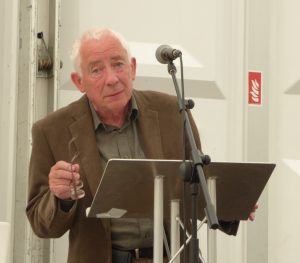 I first met Elwyn in 1961. I was a schoolboy at the time, and the circumstances of our meeting were not of the happiest, for I had received a summons to appear before him at a Pwyllgor Rhanbarth!
I had set up a school branch of Plaid Cymru at Denbigh Grammar School early in the sixties. We would meet during the dinner break in various classrooms unbeknown to the staff. This was possible because I wore a ‘Prefect’ badge (enabling me to allow pupils into the building) – but the trouble was that teachers were able to come by, open the door and enquire “What’s going on here, then?” If the teacher was English, I could just say, “Oh, it’s the Welsh Society, Sir”. And that would be fine. Once, the Religious Education teacher came and asked me if I was conducting a prayer meeting – and I regret to have to tell you that I said that I was!
In fact, there was a risk that we would be caught, but eventually we were allowed to use the Plaid office in town. However, someone complained that children were coming and going to and from the office and causing a commotion. So, I was summoned to give an account of myself and my fellow pupils before none other than Mr Elwyn Roberts.
Those of you who knew Elwyn can imagine what it felt like to appear before him! I fully understood – you can’t waffle with him. But, in fact, he found in our favour and said that we were free to use the office from then on.
Some years later, in 1968, as Dafydd Williams said, I was appointed a member of Plaid staff. I had my interview in Pwllheli following Robyn Lewis’s adoption meeting. Elwyn approached me at the end of the rally – “Right” he said, “I want you to help me fill the car boot with these pamphlets.” As I filled the boot, he asked me questions. When I had filled the boot, he said, “You’ve got the job”. That was the shortest interview of my life.
As Dafydd Wigley has said, he was a private man. And I would say that he was really a shy man. Maybe, he had a facade that shy people often adopt which gives the impression that they are less warm than they truly are. Basically, Elwyn was a warm person.
And as Dafydd Wigley has commented, when he did have some leisure time, he did not write about himself but about his native locality – the community that gave him his values. [Wrth Odre Cadair Idris] He writes about his childhood, and one sentence is quite a surprise. He refers to his school, and to a teacher of whom he was very fond, Mr Fielding. Mr Fielding’s family had come from the Netherlands, but he spoke Welsh.
And this is the sentence that struck me as unexpected: “I recall some of the lessons in arithmetic, although I hated the subject.” Says he, the conjurer with figures! The man who could conjure money from the air – and he hated arithmetic! He states that Welsh and local history were much more to his taste. Yes, love of patrimony was the foundation for his patriotism, and as Dafydd Wigley has described it, slightly old world patriotism. I would agree – his values were those of a Nonconformist Welsh-speaking Wales.
I recall that at a conference in the early seventies one of the Rhondda branches had proposed a motion calling on Plaid to set up licensed clubs. Only two speakers’ cards had been submitted – proposer and seconder. Elwyn came up to me and said, “Gwynn, you must speak!” I had not intended to speak but he insisted, “You must speak against this! Good heavens, what do you think the supporters of Goronwy Roberts, the great teetotaller, will make of this in Arfon if we pass this motion?”. And so it was that I had to speak, with two minutes’ notice, against setting up licensed clubs. The motion failed, but not because of anything I said!
Another aspect of his Nonconformist values was his pacifism. I know that it was as a nationalist that he objected to doing military service, but he could well have done so as a pacifist too.
I remember one occasion during the run-up to the Investiture when the late ROF Wynne (Garthewin) had expressed an allegedly ambiguous attitude concerning the use of violence in struggles for national freedom. A fairly prominent Plaid member spoke up in defence of ROF Wynne. Elwyn was incensed. “Him! Him of all people! If he saw a real gun, he’d wet himself!”
Elwyn could get quite cross, that has to be admitted. I remember returning from an Eisteddfod where Elwyn had been very cross with one of the party’s most faithful workers, Nans Jones. (I’m bound to say that, of the staff, it was Nans Jones who seemed to irritate Elwyn most often.) When Elwyn had gone to Y Ddraig Goch stand (in the days when political parties were banned from the Maes) what did he see under the table but copies of JE Jones’s gardening book [JE was a former Plaid General Secretary]. What Nans had been doing when she saw anyone who knew JE approach was to offer them the gardening book – rather than party literature! “And in any case”, said Elwyn, “when did JE ever find time to do gardening?”
Elwyn had been a National Eisteddfod organiser twice. [Llanrwst Eisteddfod, 1951, was one of them] One Monday he arranged for Cynan to come to Llanrwst to inspect the Gorsedd Circle as the architects had been arranging the stones in the order stipulated for them (before the advent of plastic stones – i.e. real rocks) the previous week. However, over the weekend the farmer had allowed bullocks to graze on the site. And here are Elwyn’s words, “Do you know what, the bullocks were lifting their tails against the stones – Cynan was enraged! ‘Don’t you realize’, said Cynan, ‘that those atones are sacred?’” It was clear from his expression as he told the story that Elwyn had a sense of the absurd.
One day we were discussing cars. Among the jobs that Elwyn had done was selling second hand cars. I’m sure he was a good one – he had the knack of parting people from their money – as he did many years later as Plaid’s Treasurer! He sold cars for a businessman from Colwyn Bay, Mr Bill Knowles.
Bill Knowles was quite a character, a prominent Tory, and he became Mayor of Colwyn Bay. (As it happens, during the sixties he joined Plaid Cymru, and served as chairman of Denbigh Pwyllgor Rhanbarth.) Coming back to our chat, Elwyn said, “Gwynn, if ever the radiator of your car leaks, I know how to settle it. You need to pour a packet of pepper into it, and that will seal it – something Bill Knowles taught me!” Second hand car salesmen do not always have a good reputation, but if you asked me would I buy a second car from Elwyn I would answer, “Yes, oh yes!”
I think that he could sometimes be over cautious – two small examples. A research group, under Dewi Watcyn Powell I believe, had prepared a constitution for a free Wales (for which a conference was held at the Temple of Peace for its adoption). One point that was raised was what to call the Crown’s representative. ‘Viceroy’ was out of the question, and there was a feeling that ‘Governor-General’ was too imperialist. So they suggested ‘First Citizen’. Elwyn thought that too elitist for Plaid.
“Can you think, Gwynn, of another title for the head of something?”
“Well, the ceremonial head of a University is called a Chancellor,” I said.
“Yes, I like it – Chancellor of Wales,”
“Come to think of it,” I said, “that is what the prime minister of Germany is called”.
“Good heavens – we can’t have that! Just think what the Daily Post would make of it!”
So, ‘First Citizen’ it was!
One day, I recall, we were discussing family life, I suppose, and he discovered that I was an Anglican. He felt he needed to explain something to me.
Those days every political party was invited to some place of worship on the Sunday before their conference. It had been arranged in advance, of course, who would extend the invitation.
“I must admit that I have never sought an invitation to attend a church service [i.e. as distinct from a chapel service], and I should explain why. The reason is that a church service includes a prayer for the Queen, and I’m afraid of some hothead walking out during the service – what would the papers make of that?”
Yes, over cautious, sometimes, perhaps.
But what are the lasting impressions of him? Discipline, tenacity and integrity.
Discipline – personal discipline, work discipline. If you pulled your weight, Elwyn would not be slow to express appreciation. But if he was disappointed, he would let it be known! I disappointed him once – I failed my driving test. “Damn you!”
Tenacity – perseverance in the face of difficulties. I remember summer 1969 (the summer of the Investiture) – it was a frightfully difficult period – and one of Elwyn’s main fears was that the Summer Raffle would fail! The Summer Raffle was important – it funded our wages – but Elwyn kept his nerve.
Finally, and supremely, integrity. A genuine man. I have worked for a number of people – some of them very good people – but I retain the highest respect, on account of his unsparing dedication, for Elwyn.
Elwyn Roberts
A tribute by Dafydd Williams
I got to know Elwyn Roberts after joining Plaid Cymru’s staff – supposedly for just twelve months – almost half a century ago, in December 1967. I had met him already on a number of occasions in the party conference and Summer School, as well as one never to be forgotten day shortly before the Carmarthen by-election in 1966. But it was in Plaid Cymru’s office in Pendre, Bangor that I saw the man himself at his daily work. He would be there without fail every morning, and usually would be hard at it well after the clock on the wall told us it was time to be going home.
It was an exciting time. In the wake of the Carmarthen by-election, and Rhondda West the following year, and with Gwynfor in the House of Commons, new members were flocking in, and the aim was to channel that growth into an effective pattern of branches and constituency organisations. As General Secretary and Chief Organiser – that was his job title – Elwyn Roberts had the job of dealing with all the issues that accompanied that rapid growth, and a steady stream of callers who would drop in.
I soon came to see that it took someone of exceptional talent, experience and character to occupy that key role. Someone who would keep the ship on course whatever the weather. And there was no doubt that Elwyn Roberts was that person. Of course he worked in the background. Although he was fully capable of addressing councils or conferences if need be, the public stage was not his natural environment.
I still have a vivid picture of him, at his desk in his sports jacket – it wasn’t often that he took that off – and a handkerchief neatly folded in his top pocket. Working with him at that time in Bangor was a young woman from the Llŷn peninsula, Nans Gruffydd – by now Nans Couch. Nans is unable to be with us today because of family duties, but I am very grateful for her recollections.
This is how Nans recalls Elwyn Roberts: “He was definitely one of my heroes in Plaid Cymru and it was a privilege to work with him. Elwyn was someone who went the second mile – a tireless worker who gave up his career in the bank in order to serve his nation. He was the strongest influence on me … working with Elwyn was better than any college”.
Elwyn was fond of his tea. Just about every hour in the afternoon, it seemed, both of us would hear his voice from the back room: “Is there something warm in the teapot?” And – cue a confession! – it was Nans who would put her work to one side and prepare another pot of tea. This was 1967, remember!
Of course, long before either Nans or I came on the scene, Elwyn had already given decades of his life to Wales and Plaid Cymru – and through times of great difficulty. For example:
- Elwyn served as election organiser to Gwynfor Evans in Meirionnydd in 1945, winning praise for his “proverbial hardness” as agent according to the author Rhys Evans – by the way, during that campaign, he arranged a public meeting before the memorial to Hedd Wyn in Trawsfynydd – at 11:30pm in the night!
- Ten years later in 1955 – released by Plaid Cymru to rescue the struggling Parliament for Wales campaign, and succeeding as well.
- Or this – in 1961, raising £62,525 to launch Teledu Cymru.
And there is no way I can relate all his work in raising funds to keep Plaid Cymru from going bankrupt – time after time and in all sorts of ways. No wonder that in Rhys Evans’ magisterial biography of Gwynfor Evans he gets 45 mentions.
In 1971, and quite unexpectedly, I became the successor to this unique figure in the history of Plaid Cymru, following a walk on the prom in Aberystwyth with Gwynfor, but that is another story! How on earth could I hope to fill his shoes? I knew there was no way I could imitate him.
But fortunately for me and the party, if Elwyn was retiring as General Secretary, his contribution to Plaid Cymru was far from being over. In the same year, his was elected as party Treasurer – a post he had in reality been doing for years. And, however much some of you may doubt it, thanks to his hard graft in an improved political atmosphere Plaid’s financial situation markedly improved.
He went on to carve out a whole new career as an elected member of Gwynedd County Council representing Bodorgan here in Anglesey and holding a number of public posts – among them the Development Corporation for Wales and Gwynedd Health Authority.
I was fortunate enough to call at his home a number of times – a bungalow named Peniarth on the corner of a small rural lane in the village of Bodorgan, with a grouted roof in the style familiar in Anglesey (I heard a lot about ‘grouting’!) and an immaculate interior. I was sure of a warm welcome and every kindness from Elwyn and his wife Nansi – it is sad to think that Elwyn spent the last years of his wife without her lively company.
I learnt of his death when I phoned Gwerfyl in the national office the day before his funeral while on holiday with my parents in Scotland, and unable to get back in time for his funeral. It was a comfort to visit his last resting place in Abergynolwyn a few months later.
I would like to end with an appeal. There is a real need to set down the history of this unique hero – the banker who became organiser of a national movement. The raw material is ready – volume upon volume of his papers in the National Library, and no shortage of red ink! It is a story worth telling – a subject worthy of a PhD and a book to follow. What about it, you historians?
For my generation, and the younger generation, the story of Elwyn Roberts is an inspiration – and a challenge. The success of Plaid Cymru today, whatever the difficulties, stem from the seeds planted by Elwyn and his contemporaries.
It is difficult to believe that his time came to an end nearly a decade before our country won the battle to secure its own national assembly. He would have been overjoyed – and would have given anything to played his part in that victory. We give thanks for his life and his work.
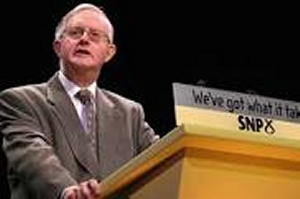 Gordon was a great friend of Wales and a totally committed nationalist. We had met in the 1965 Plaid Cymru summer school in Machynlleth when he was National Secretary of the SNP, and he visited Wales on many occasions. We were both elected to Westminster in February 1974 and were colleagues during the fraught days of the 1978 Devolution Acts and the 1979 Referenda when the iniquitous 40% rule prevented Scotland from getting their National Assembly, although a majority of those voting in Scotland had supported it. In the following election, after the downfall of the Callaghan government, the SNP lost 9 of their 11 seats – with just Gordon and Donald Stewart surviving, as colleagues for Dafydd Elis Thomas and myself. We continued to argue the case for our two nations, until Gordon lost his Dundee seat in 1987. By then Margaret Ewing and Andrew Welsh had regained their seats, and they were joined by Alex Salmond, leading to the campaign that eventually, in 1997, secured our respective parliaments. Gordon was a key person, at a critical time, in the emergence of the SNP as a major parliamentary party. Modern-day Scotland owes him a debt of gratitude and we in Wales salute his memory.
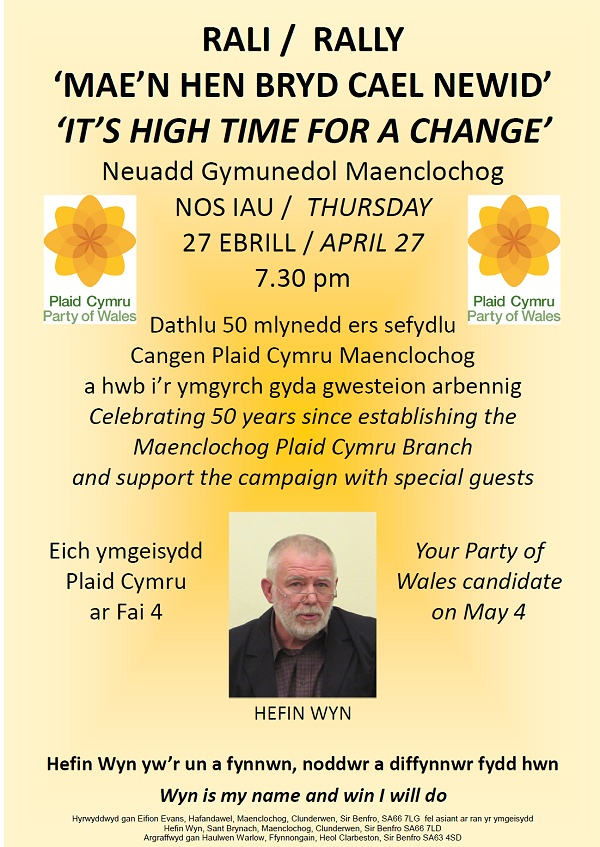 The evening will recall those events, but also look forward to the new challenges facing Pembrokeshire and Wales in the 21st century, said Hefin Wyn, who will be contesting a seat on the county council in the elections on 4 May.
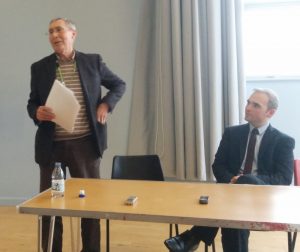 Hywel Davies graduated in International Politics at University College, Aberystwyth and was a Research Student at University College, Cardiff. He is a former editor of the Merthyr Express and was also a television journalist and producer/director with HTV/ITV Wales and Nant Films. His book ‘The Welsh Nationalist Party, 1925-1945: A Call to Nationhood’ remains a classic text on the foundation and early decades of Plaid Cymru.
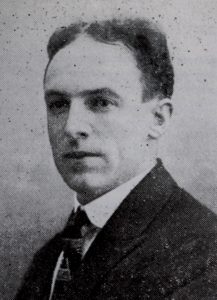 DJ had been born in 1893 near Carmel not far from Cross Hands. He followed his father by becoming a boy collier at Cross Hands and then worked underground with his elder brother at Bedlinog. His father, Thomas Davies, was from Carmarthenshire but had been a miner in the Rhondda before returning to Cross Hands. His mother, Elen Williams, who died when DJ was 14, was from Ferndale in the Rhondda Fach. So DJ Davies was born into a typical Welsh mining family, and was apparently set for a future in the mines of southern Wales. But in 1912, in a remarkable grasping at a different life, this lively and ambitious lad, aged only 19, decided to apply for the American Dream – and he had a really good shot at it.
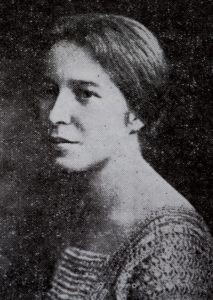 The names of DJ and Noëlle would become inextricably entwined. In my view, no one can talk about DJ Davies without talking, too, about Noëlle – “Y ddihafal Ddr Noëlle,” as DJ Williams described her, ‘the peerless Noëlle’!
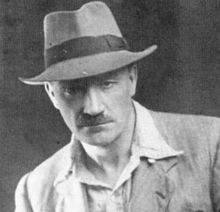 Glamorgan to save James Connolly from execution. He failed; Connolly was shot the morning White was arrested.